
| Watch for | Proprietary blends that hide per-ingredient amounts — a transparent label lists each one. |
| Look for | Standardized extracts, named amounts, and elemental figures for minerals. |
| Quality seals | GMP-certified, registered facility, non-GMO, third-party or in-house testing. |
| Compare fairly | Per-serving actives and cost per day — not headline totals. |
A nerve supplement label is a small block of text that quietly decides whether you are getting a genuinely useful product or an attractively packaged disappointment. Learn to read it and you can tell the two apart in about thirty seconds. This buyer’s guide walks through every part of a nerve-support label — the Supplement Facts panel, proprietary blends, standardized extracts, elemental amounts, fillers and quality seals — so you can shop on substance instead of marketing.
Every legitimate supplement sold in the United States carries a Supplement Facts panel, and it is the first place to look — not the glossy front of the box. The panel is standardised by regulation and tells you the serving size, the number of servings per container, and each ingredient with its amount per serving and, where one exists, its percentage of the Daily Value. The marketing lives on the front; the truth lives on the back. Train yourself to flip the bottle over first, every time. The NIH Office of Dietary Supplements explains how the panel is regulated and what a Daily Value figure means in “Dietary Supplements: What You Need to Know”.
Two numbers on the panel do quiet but important work. Serving size tells you how many capsules make up the amounts listed — a “900 mg” claim means little until you know whether that is per capsule or per three-capsule serving. And servings per container is what lets you work out the real cost per day, which is the only fair way to compare price.
If there is one label term worth understanding above all others, it is the proprietary blend. A proprietary blend groups several ingredients under a single total weight — say “Calming Nerve Blend 900 mg” — without telling you how much of each individual ingredient is inside. It is perfectly legal, and manufacturers sometimes use it to protect a genuine recipe. But it creates a real problem for the buyer: an impressive-looking blend could contain a meaningful amount of one hero ingredient and little more than a pinch of the rest. It is not only a disclosure question: Ichim and colleagues reviewed chemical authentication studies of commercial herbal products in Frontiers in Pharmacology, 2021, and found ingredient mismatches to be common (PubMed 33935790).
This does not mean every blend is a red flag. It means you should read one with your eyes open. A more transparent label lists each active ingredient with its own amount, so you can see exactly what you are paying for. When a blend is used, look for a maker that at least names the ingredients in order (they must be listed by weight, most first) and ideally discloses the key amounts anyway.
Botanical potency varies. The same herb grown in two places, or harvested in two seasons, can contain different levels of its active compounds. Standardization is how a good manufacturer controls for that. A standardized extract is processed so that each batch contains a consistent, measured level of a marker compound — for example, “standardized to 3.5% flavonoids.” It is the difference between a botanical that performs consistently bottle to bottle and one that is a bit of a lottery. Vitamins have their own version of this problem, where the chemical form on the label changes what you absorb — the clearest case is benfotiamine versus plain thiamine.
When you see a standardization statement, it tells you the maker is measuring what goes in rather than hoping. This matters most for the calming botanicals people buy for nerve support. If you want to see how standardization applies to a specific plant, our guide to passion flower for nerve health shows exactly what a good passion flower entry looks like on a label.
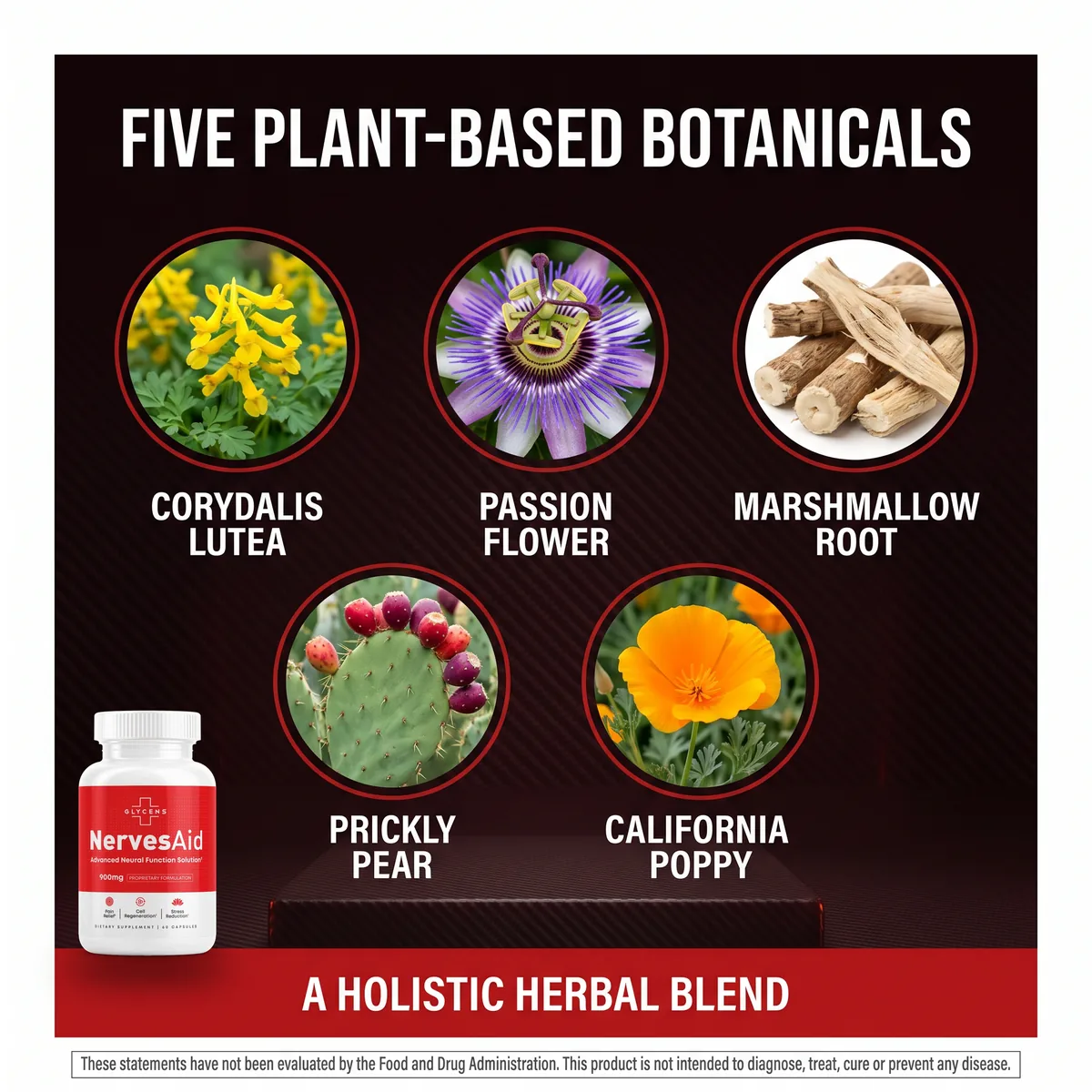
Transparency is exactly the standard a well-built formula holds itself to. NervesAid, for instance, names all five of its botanicals — passion flower, California poppy, corydalis, marshmallow root and prickly pear — rather than hiding them inside an unnamed blend, so you can research each one. If you are weighing individual plants, our comparison of corydalis vs California poppy shows how naming the species helps you tell similar botanicals apart.
If a nerve supplement contains minerals, there is a specific number to check. Minerals such as magnesium are bound to other compounds, and the label weight often refers to the whole compound rather than the usable mineral. The amount you actually absorb is the elemental amount. A large headline figure can shrink dramatically once you look at the elemental number, so always compare that — never the compound weight. We cover this in depth, form by form, in our guide to magnesium for nerves, and the same principle applies to any mineral you see on a nerve label.
NervesAid™ lists all five botanicals openly in one plant-based daily capsule — a 900 mg blend, non-GMO and made in the USA, backed by a 60-day money-back guarantee.
See NervesAid PackagesBelow the Supplement Facts panel you will usually find a short line of other ingredients — the capsule shell, flow agents, stabilisers and so on. It is easy to treat all of these as suspicious “fillers,” but that is a misunderstanding. Many are functional and harmless: they let a machine produce a consistent capsule and keep the product stable on the shelf. The real value of this line is transparency. You want to see it listed so you can scan for anything you personally avoid — a specific allergen, gelatin if you are vegetarian, or a colour or additive you prefer to skip.
Seals and certifications are shorthand for how a product is made. None of them proves an ingredient works, but together they tell you whether the maker follows recognised standards: Independent laboratory analysis of marketed supplements by Crawford and colleagues in JAMA Network Open, 2022 found products whose measured contents did not match their labels, which is exactly what a third-party seal is meant to guard against (PubMed 35947382).
Treat seals as necessary hygiene rather than proof of benefit. A well-made product should clear these bars and tell you clearly what is inside and how much.
Put it all together and you can size up almost any nerve supplement in under a minute:
For the broader routine these products fit into — sleep, food, movement and consistency — see our overview of how to support nerve health naturally.
Give any routine a steady few weeks to settle in. The multi-bottle NervesAid™ packs keep your daily step going without gaps — at the best per-bottle value.
Order NervesAid Multi-Packs
A proprietary blend lists several ingredients together under one total weight without disclosing how much of each is included. It is legal and sometimes used to protect a recipe, but it also means you cannot verify whether an active ingredient is present in a meaningful amount. A transparent label lists each ingredient with its own amount.
Standardization means the extract is processed to contain a consistent, measured level of a marker compound in every batch — for example a set percentage of flavonoids. It helps ensure the product you buy this month matches the one you bought last month, which matters for botanicals whose potency can vary.
Look for GMP-certified manufacturing (Good Manufacturing Practices), a made-in-a-registered-facility statement, non-GMO and allergen-free markers where relevant, and third-party or in-house purity testing. These signal that the maker follows recognised quality standards, though no single seal guarantees an ingredient works.
Not necessarily. Some “other ingredients” are harmless and functional — capsule material, flow agents and stabilisers that help manufacture a consistent product. The point is transparency: you want to see them listed so you can check for anything you personally avoid, such as specific allergens.
Compare per-serving amounts of the named active ingredients, not headline totals; check for standardized extracts and elemental amounts; note the serving size and servings per container for true cost per day; and weigh quality markers. A cheaper bottle can be more expensive per usable dose.
† These statements have not been evaluated by the Food and Drug Administration. This product is not intended to diagnose, treat, cure or prevent any disease. This article is for general information only and is not medical advice.